Suche
Newsletter abonnieren
News
Branchenverzeichnis


Sonderhefte/Specials

Shuttle-Profis


Fotostrecken

Coordinating robots without common standards? What role large AI models could play

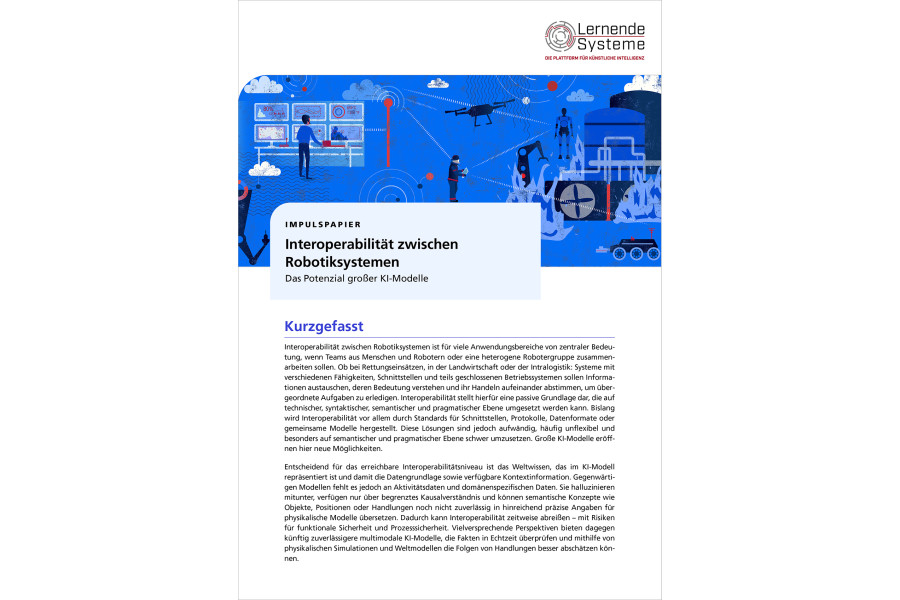
The position paper distinguishes four levels of interoperability. At the technical level, it's about connecting different systems. The syntactic level ensures that data formats are compatible with each other. The semantic level concerns the understanding of the meaning of exchanged information. At the pragmatic level, systems must also be able to consider the impact of actions in their respective application context.
The authors emphasize that while interoperability creates the foundation for communication and cooperation between different systems, it does not automatically lead to coordinated joint actions. The pragmatic level, in particular, is therefore relevant for the coordination of complex tasks.
Large AI models should interpret information
According to the authors, large models of artificial intelligence could particularly improve semantic and pragmatic interoperability. In addition to large language models, systems designed for logical reasoning or those that integrate language processing, visual perception, and action planning are also conceivable.
Such models could classify information from different robotic systems and make it usable for joint coordination. The world knowledge available in the model plays a crucial role in this. Its scope and quality depend, among other things, on the data used during training. Added to this are context information provided to the models during ongoing operations. This way, large AI models could offer a complementary opportunity to support the collaboration of different robotic systems. The focus here is not solely on the transfer of data, but on their interpretation in the context of the respective tasks and environment.
Limits in Reliability and Physical Understanding
For practical applications, however, significant limitations remain. According to the platform Learning Systems, current generative AI models often lack sufficient activity data and application-specific information. Additionally, the models can generate incorrect statements and have limited ability to understand cause-effect relationships.
Another challenge is to reliably translate information about objects, positions, or actions into precise data for physical models. This is a prerequisite for coordinating actions, especially in the collaboration of physically acting robotic systems.
According to the position paper, inadequate or incorrect interpretations can lead to the temporary interruption of interoperability between the involved systems. This can lead to risks for both functional safety and process security.
The authors therefore see a need for further development in the reliability of large AI models and their ability to accurately represent physical relationships. Functions for safety-relevant applications must be reliably available.
Multimodal Models and Simulations as Development Perspective
The authors see a potential advancement in more powerful multimodal AI models. These should jointly process different types of information and thereby improve the interpretation of complex situations.
The white paper also mentions real-time fact-checking and the connection of large AI models with physical simulations and world models as further approaches. This would enable robotic systems to better estimate the impacts of planned actions and coordinate their activities accordingly. However, for practical use, the fundamental availability of such functions is not sufficient. What matters is that the models can reliably provide the required information and capabilities under real-world conditions.
Research and Industry Should Develop Applications
The Learning Systems Platform sees interoperability as an important area of development for the joint use of different robotic systems. However, the approaches described in the white paper are still under research or need further development for practical use.
Experts involved consider closer collaboration between user companies, robotics manufacturers, and research institutions necessary for the transfer of corresponding concepts into marketable solutions. This involves particularly connecting technical possibilities with specific requirements from industrial applications.
The white paper titled "Interoperability between Robotic Systems - The Potential of Large AI Models" was developed by members of the working groups "Adaptive Robotic Systems" and "Technological Pioneers and Data Science" from the Learning Systems Platform. It examines the possibilities of large AI models for the communication and coordination of heterogeneous robotic systems as well as the existing challenges for reliable and safe use.
The study can be downloaded at the following link: Interoperability between Robotic Systems: The Potential of Large AI Models
Translated automatically from German.
Branchenverzeichnis