Suche
Newsletter abonnieren
News
Branchenverzeichnis


Sonderhefte/Specials

Shuttle-Profis


Belt conveyor or toothed belt conveyor: Which system is suitable for which task?

Modular Conveyor Technology for Various Transport Tasks
Belt and toothed belt conveyors can be adapted to various production processes. System provider Item combines standardized conveyor technology with different drive concepts and accessory components for this purpose. An application at packaging specialist KM Packaging shows how assembly and packaging processes can be automated with this technology.
In industrial manufacturing environments, the demands for a reliable in-house material flow are increasing. Components, workpieces, and packaging units must be transported between machines, workstations, process cells, and storage areas. At the same time, companies face the task of reducing lead times, optimizing personnel resources, and stabilizing production processes. While larger companies often already use automated conveyor systems, material transport in smaller and medium-sized enterprises is sometimes still manual. Particularly in situations with limited space, increasing production volumes, and growing variety, such processes can reach their limits. Interruptions in the material flow not only affect individual workstations but can also impact downstream production steps and delivery capability.
Standardized Components for Different Systems
Modular conveyor belt systems allow transport routes to be tailored to specific production conditions. By combining standardized components, different conveyor lengths, belt widths, and drive concepts can be realized. The systems can be used for individual transport tasks as well as part of automated production lines. Compact dimensions and various mounting options facilitate integration into existing machines and systems.
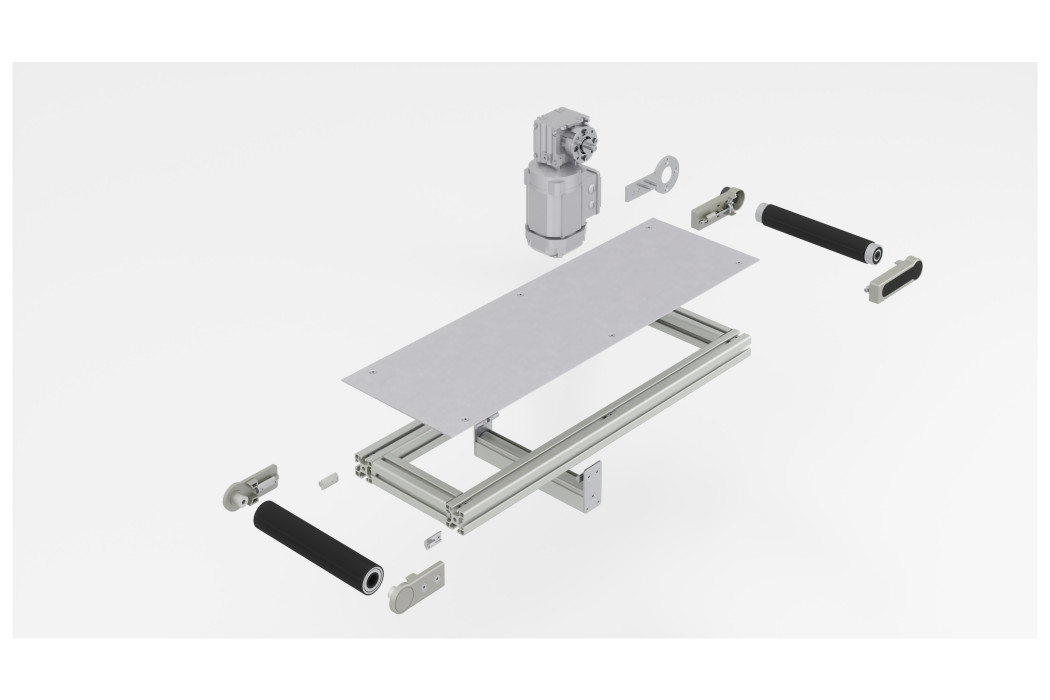
The item Industrietechnik GmbH offers a corresponding modular concept. The company provides various conveyor belt systems, whose components can be combined according to the technical requirements. These include drives, deflections, tensioning systems, as well as drive and deflection rollers, among others. Users can obtain fully pre-assembled conveyor units or assemble the required individual components themselves. This allows transport routes to be configured both for new systems and for the expansion of existing production areas.






Belt Conveyors for Different Transport Goods
The suitability of conveying technology depends, among other things, on the properties of the transported goods, the required conveying capacities, and the conditions at the site of use. Item distinguishes between belt conveyors and toothed belt conveyors, which differ in terms of power transmission and their areas of application.
Belt conveyors are particularly suitable for sensitive, differently sized or shaped transported goods. The movement of the conveyor belt occurs through frictional connection: the drive roller transfers its movement through friction to the belt. The system can be used for moderate loads and wider conveying surfaces. According to the manufacturer, belt widths ranging from 40 to 400 millimeters as well as various belt materials are available. This allows components, containers, or packaging units to be transported between individual production stations, for example.
Toothed belt conveyors, on the other hand, use a form-fit power transmission. The interlocking between the belt and drive roller allows for the transport of higher loads and supports precise positioning of the conveyed goods. At the same time, these systems are characterized by smooth operation. They are therefore particularly suitable for heavier workpieces or applications where defined transport movements are required. The choice between belt and toothed belt conveyors thus depends on the mechanical properties of the goods and the requirements of the respective manufacturing process.
Double Conveyors Create Space for Additional Functions
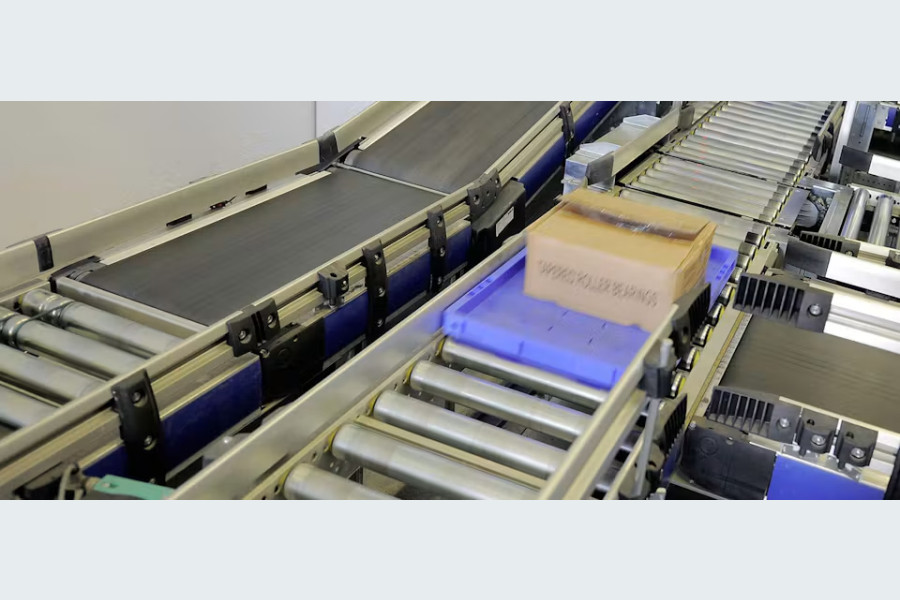
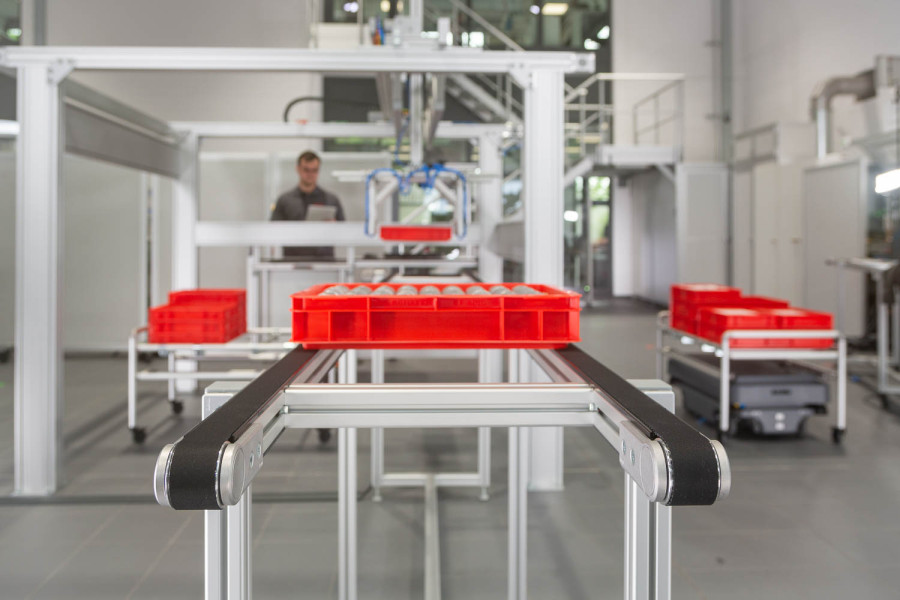
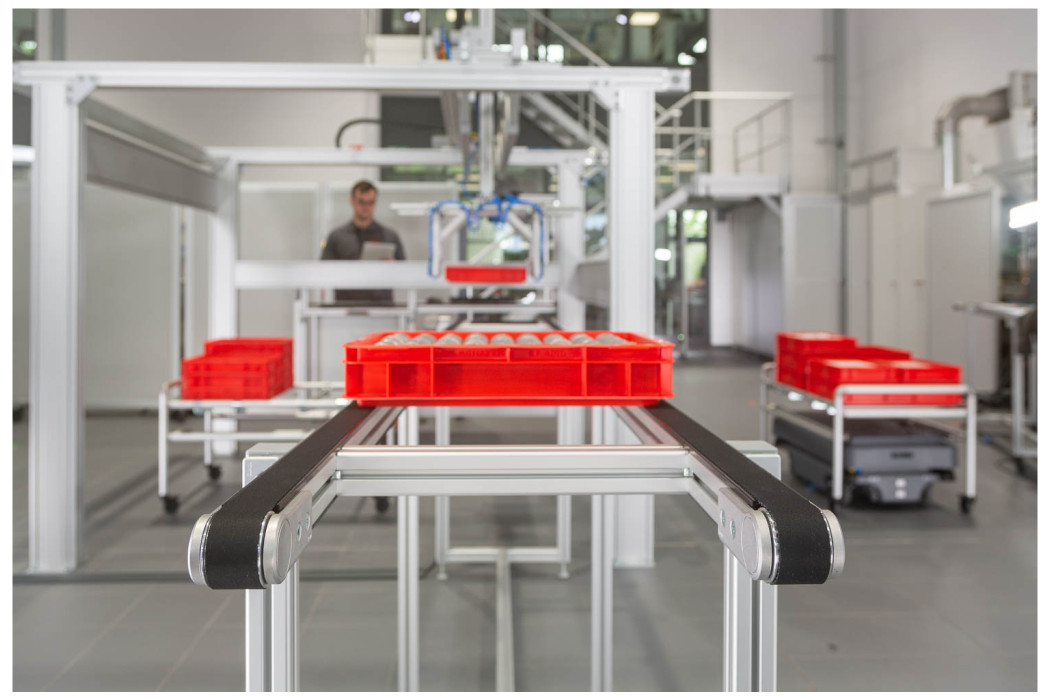
Both types of conveyors are also available as double conveyors with two parallel running belts. This design is suitable for self-supporting transport goods, such as cartons or boxes, which rest on two separate conveying surfaces. Space remains between the belts for additional technical components.
For example, sensors for the optical detection of transported containers can be installed there. Actuators that stop or accumulate the transported goods at defined positions can also be integrated into the intermediate space. Thus, double conveyors can take on additional functions within automated production processes besides the actual transport. The arrangement of the two conveying strands also creates structural space for components that would need to be positioned differently on a continuous conveyor belt.
Integration into Machines and Workstation Systems
The conveyor belt systems are based on the profile technology of Item's series eight. This allows them to be connected with other components of the system kit. Possible areas of application include machine cabins, industrial workstation systems, and applications according to lean principles.
The modular framework serves as a constructive basis for integration into existing plant structures. A lateral groove on the conveyor belt enables the attachment of additional elements. These include side guides, sensors, cameras, and stoppers. This allows the conveyor technology to be supplemented with functions for monitoring, capturing, and controlling material transport. Even with a subsequent expansion, standardized mounting points can be used as long as the respective components are compatible with each other.
Side Guides for Containers and Workpieces
For the lateral guidance of the transported goods, Item offers the railing system "8 D8". It can be adjusted in width, height, and pivot area and adapted to different dimensions of the transported goods. Besides guiding during transport, the system can also be used for funneling, accumulating, or singling out workpieces.
The construction consists of a railing holder that is attached in the lateral groove of the conveyor belt, as well as brackets in various sizes. These allow adjustment to different transport goods heights and widths. Among the intended areas of application is the transport of small load carriers with standardized dimensions. Containers and bulk material can also be guided with appropriate lateral boundaries.
Through the adjustment options, the guiding system can be adapted to changing transport tasks. This means different container formats or workpieces can be transported on a conveyor route, provided the other technical requirements of the system are met.
Dissipative Conveyor Belts for Sensitive Components
During the manufacturing and processing of electronic components, electrostatic discharges must be considered. Such discharges can damage sensitive components and impair the quality of the products. For such applications, Item offers electrically dissipative conveyor belts and timing belts.
According to the manufacturer, the solutions are intended for use considering the IEC/DIN EN 61340-5-1 standard. Conductive materials are supposed to control the dissipation of electrical charges. These include, among other things, a stainless steel sheet beneath the conveyor belt and special timing belt guide rails. Grounding occurs via the motor.
The range also includes the "PUR ESD" accumulable conveyor belt. It features a low-friction, durable surface designed to support gentle transport of the goods. Thus, another belt variant is available for applications with electrostatically sensitive components. The choice of suitable transport medium depends both on the requirements for electrostatic dissipation and on the characteristics of the goods to be conveyed.
Three Drive Concepts for Different Installation Situations
Different drive concepts are available for the conveyor belt systems. They differ particularly in the position of the motor, the required installation space, and the possible conveying directions. The selection is based on the intended system geometry and the requirements of material transport.
With direct drive, the motor is attached directly to the drive roller. This design requires relatively little space and, according to the manufacturer, enables a cost-effective setup. However, the direct drive is limited to one conveying direction.
An alternative is the center drive. In this concept, the motor is located below the conveyor belt, leaving additional installation space above the conveyor line. Unlike direct drive, this arrangement allows for both conveying directions. This can be particularly relevant if goods need to be moved forward and backward within a system.
As a third variant, Item announces an indirect drive. This is intended to combine properties of the other two concepts. Like the direct drive, it is designed for one conveying direction.
Practical Example: Automation at KM Packaging
How modular conveyor technology can be integrated into industrial processes is demonstrated by an application at the packaging specialist KM Packaging. The company wanted to automate its assembly and packaging processes with a standardized solution. The requirements included a small number of interfaces, rapid assembly, and components that can be used internationally. The company also valued durability and operational safety.
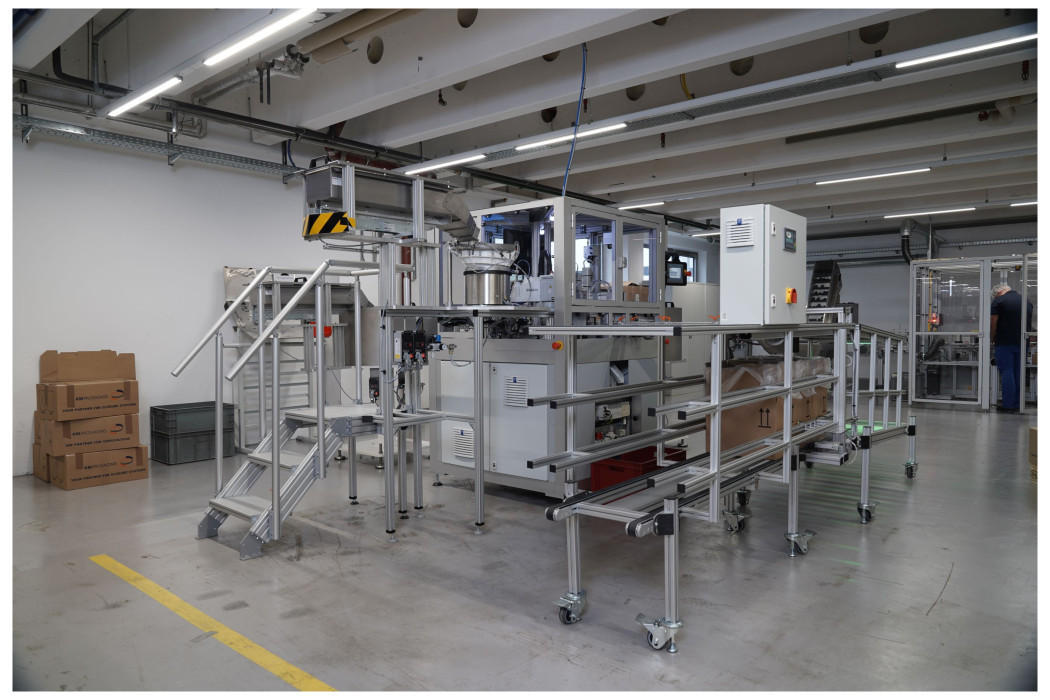
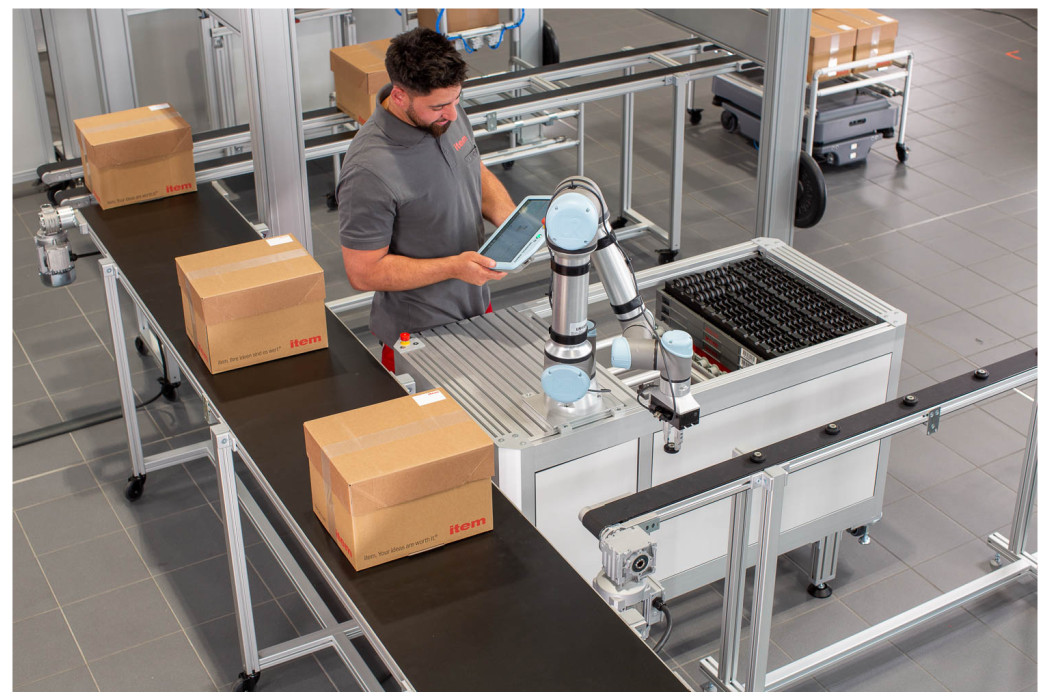
For implementation, conveyor belt systems and other components from Item are used. Belt conveyors transport various components, including cannulas, thread rings, and closure caps, to a rotary assembly station. There, the individual parts are assembled and then inspected. According to the conveyor technology manufacturer, this process is largely automated.
In the further production process, additional conveyor lines take over the transport of the finished closures to a filling station. Empty cartons are provided via double belt conveyors. This ensures that both the supply of individual components for assembly and the subsequent material transport are integrated into the automated processes.
In addition to the conveyor lines, the machine cabin and other system components were also constructed with elements from the Item modular system. By using integrated components, the packaging specialist was able to build various areas of the system with a common construction system.
Digital Configuration Supports System Planning
The planning and configuration of the conveyor technology for KM Packaging's project was carried out using Item's browser-based engineering tool. The software allows conveyor belts to be assembled according to specific requirements and supplemented with additional system components. The configured units can then be directly ordered.
Alternatively, the required components can also be selected via the manufacturer's online shop. The digital planning system provides functions for automatically creating parts lists and for price calculation. This allows users to determine during configuration which components are necessary for the planned conveyor line and what costs result from the assembly.
The connection between design and ordering is intended to particularly support the planning of standardized conveyor systems. Changes to the configuration can be taken into account within the digital system. For companies that want to implement different transport tasks with components from a modular system, this approach provides an alternative to the individual assembly and manual recording of individual components.
Modular Design for Existing Production Environments
The example of KM Packaging illustrates how conveyor technology can be combined with other system components into automated assembly and packaging systems. While belt and toothed belt conveyors cover different requirements for loads, goods to be transported, and positioning accuracy, additional guiding elements, sensors, and actuators allow adaptation to individual process steps.
For system planning, in addition to selecting the appropriate conveying principle, spatial conditions, the required conveying direction, and the properties of the transported goods are particularly decisive. Standardized interfaces and digital configuration options can support the assembly of the required components.
The system variants offered by Item can be used both in independent transport routes and in more complex production systems. The modular concept allows for different executions on a common constructive basis. This enables companies to adapt conveyor lines to their respective production and logistics processes without having to develop a completely independent design for each transport task.
Translated automatically from German.
Branchenverzeichnis