Suche
Newsletter abonnieren
News
Branchenverzeichnis


Sonderhefte/Specials
Shuttle-Profis


Fotostrecken

Knapp establishes robotics company and sets up innovation center in Boston


With the new establishment, Knapp consolidates its robotics activities into a unified organizational structure. While Graz will continue to serve as the competence center for robotics development and logistics, Boston is set to strengthen international technology development with a focus on industrial applications. Both locations are intended to closely integrate research, product development, solution planning, and implementation.
According to Knapp AG, Knapprobotics.ai will assume group-wide business responsibility for robotics. The company consolidates product management, development, and implementation under a unified leadership. With this structure, the provider aims to shorten development cycles, transfer new technologies more quickly into customer applications, and expand the international marketing of its robotics solutions.
At the same time, the organization is intended to help consider requirements from different markets in product development. According to the company, the focus is on scalable solutions suitable for industrial use in automated warehouse and fulfillment processes.


Robotics Lab with Up to 35 Employees
A robotics lab is being established in Somerville, where specialists in software development, artificial intelligence, mechatronics, and robotics are expected to collaborate. By early 2027, Knapp plans to build a team of about 30 to 35 employees, approximately 20 of whom will be dedicated to software development.
In its personnel planning, the company relies on a combination of experienced employees from the Knapp Group and new specialists from the technology and robotics sector in the Boston area. The location is intended to utilize existing development knowledge while also building additional competencies.
Wolfgang Toferer will take over as Chief Executive Officer of the new company. Along with Christopher Reiß as Chief Operating Officer and Thomas Zilk as Vice President, he is responsible for the organizational structure and further development of Knapp Group's global robotics business.
Physical AI for Automated Warehouse Processes
A technological focus of the new company is on applications of the so-called Physical AI. These are systems that can perceive their environment, make decisions, and perform physical tasks with the help of artificial intelligence. Knapp aims to further develop appropriate technologies for various processes within automated warehouse and fulfillment systems.
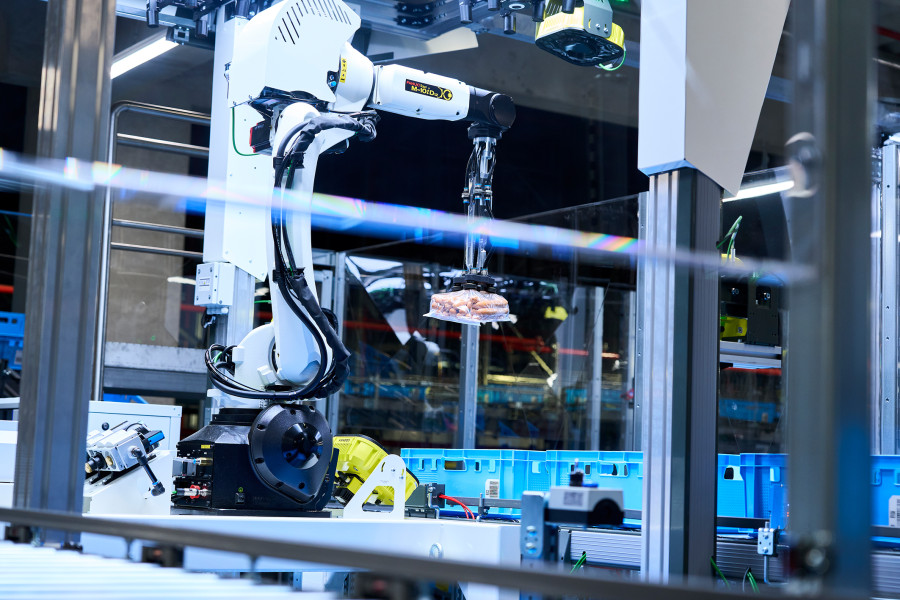
The intended areas of application include piece picking, where robots grab and handle individual items. Bin picking involves the robot-assisted removal of objects from containers. Other application fields are decanting, which is the transferring of goods between load carriers, as well as cycle counting for inventory control. Additionally, Knapp is exploring other robot-assisted processes along the internal flow of goods.
The technological foundation is the "Knapp Brain" platform. It combines computer vision and artificial intelligence methods with the planning of gripping points and robot movements. Added to this are functions for continuous learning.
According to company information, the platform is intended to form the basis for robotic solutions that can be used in different logistical applications and scale economically. The further development aims to transform new approaches from robotics research into industrially usable systems.
Collaboration with MIT Environment to be Expanded
The choice of the new location is significantly influenced by the proximity to research institutions and technology companies in the Greater Boston area. In particular, the environment of the Massachusetts Institute of Technology is expected to facilitate access to scientific developments and specialized professionals.
According to its own statements, Knapp has been collaborating with actors from the institute's environment for several years. Since 2026, the company has been a member of the MIT Industrial Liaison Program. This program serves to network companies with the institute's research and technology environment.
Furthermore, the intralogistics specialist is exploring additional cooperation opportunities in the fields of robot learning, computer vision, autonomous systems, simulation, and smart robotics. The proximity to research institutions aims to facilitate professional exchange and support the transfer of scientific findings into industrial applications.
By connecting the development sites in Graz and Boston, Knapp aims to advance the further development of its technology platform, "Knapp Brain". The new entity is set to coordinate both the technological development and the implementation and market introduction of corresponding robotics solutions within the corporate group.
Translated automatically from German.
Branchenverzeichnis