Suche
Newsletter abonnieren
News
Branchenverzeichnis


Sonderhefte/Specials
Shuttle-Profis


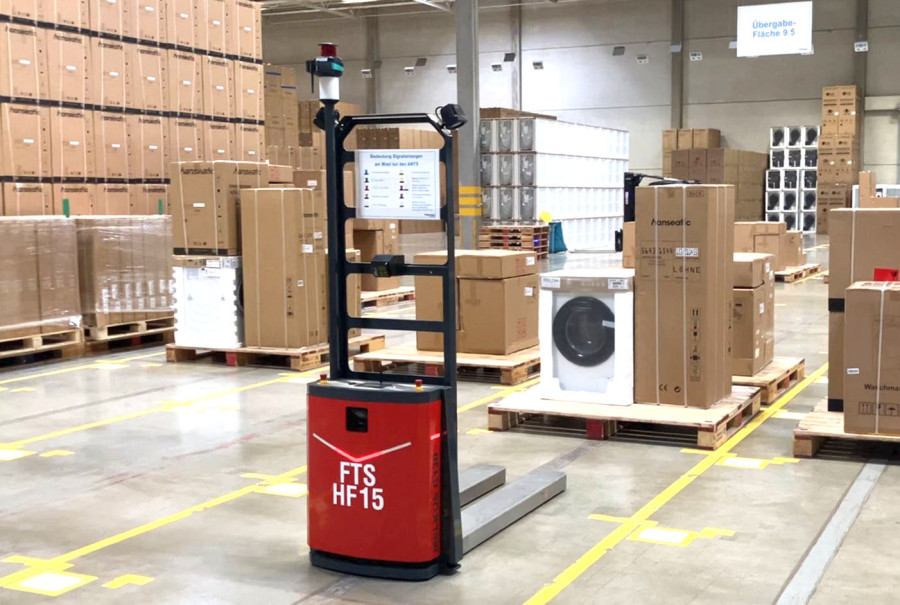
Hermes automates pallet transport with 28 AGVs from Melkus Mechatronic

Designed for 1,000 Shipments Daily
With the introduction of driverless vehicles, the two logistics companies are pursuing several goals. In addition to easing the workload of employees, they aim to increase the number of daily transports, shorten processing times, and stabilize process flows.
The transport of 1,000 shipments per day, each weighing up to 1,000 kilograms, is cited as the planning goal. The goods are provided on pallets of different formats. A technical requirement is the ability to autonomously recognize and pick up the pallets even with position deviations within a tolerance range of 20 centimeters.
Additionally, there are the conditions of mixed traffic. The travel routes are not exclusively used by automated vehicles. Forklifts and pedestrians also move on the same traffic areas. Therefore, the vehicles must recognize obstacles and adjust their movements to the respective traffic situation.
Omnidirectional Drive Simplifies Pallet Pickup
For automation, Hermes Fulfilment and Hermes Einrichtungs Service jointly procured 28 vehicles of the "Melkus G130 2.0" type. According to the manufacturer, their maximum payload is 1,200 kilograms each. Thus, their carrying capacity exceeds the shipment weight intended for the transport task, which is a maximum of 1,000 kilograms.
A key technical feature is the omnidirectional drive. This allows the vehicles to move in different directions without requiring conventional maneuvering. The vehicles can thereby independently position themselves in front of the pallets to be picked up.
To capture the environment and load carriers, Melkus Mechatronic uses laser scanners with a detection range of 360 degrees. The sensors support precise localization of the pallets and the subsequent load pickup. This also allows pallets to be accounted for whose actual position deviates from the target position within the specified tolerance range.
Navigation without Additional Infrastructure
The driverless transport vehicles utilize a method for simultaneous localization and mapping for orientation. In doing so, the vehicles capture their environment and determine their own position within the transport area. According to the manufacturer, no additional fixed navigation aids are required for this.
The laser scanners also serve to detect obstacles. This is particularly relevant in the shared traffic areas between the two halls and in the connecting corridor. The vehicles are supposed to detect unplanned obstacles as well as people in order to avoid collisions.
The combination of autonomous navigation, pallet recognition, and omnidirectional drive forms the technical basis for the automated transport between the distribution warehouse and the main transshipment base.
Fleet Expanded, Empty Pallet Transport Planned
According to the companies, the vehicle fleet at Hermes Einrichtungs Service was expanded just one year after its introduction. Furthermore, it is intended to expand the area of application for the existing vehicles. In the future, the driverless transport system should also undertake the return transport of empty pallets.
Translated automatically from German.
Branchenverzeichnis