Suche
Newsletter abonnieren
News
Branchenverzeichnis


Sonderhefte/Specials
Shuttle-Profis


Secure hold through vacuum anchoring: Timmer develops mobile tube lifting system without heavy counterweight

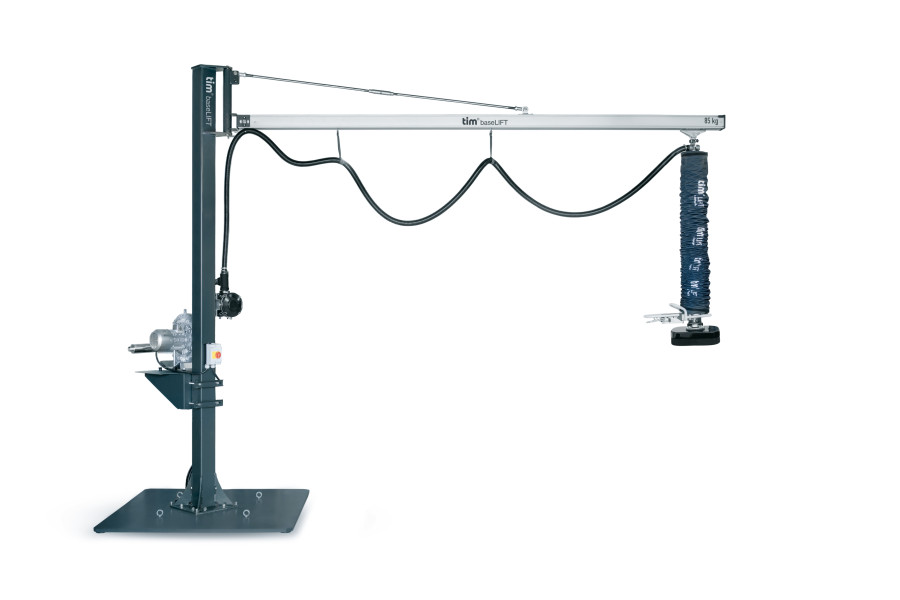
When installing crane systems in production and logistics halls, structural limitations can make the use of fixed-mounted solutions difficult. These include underfloor heating, low ceiling load capacities, or suspended ceilings. In particular, necessary drilling for floor anchoring cannot always be carried out under such conditions. Mobile crane systems with concrete or steel bases represent an alternative, but they come with a comparatively high dead weight.


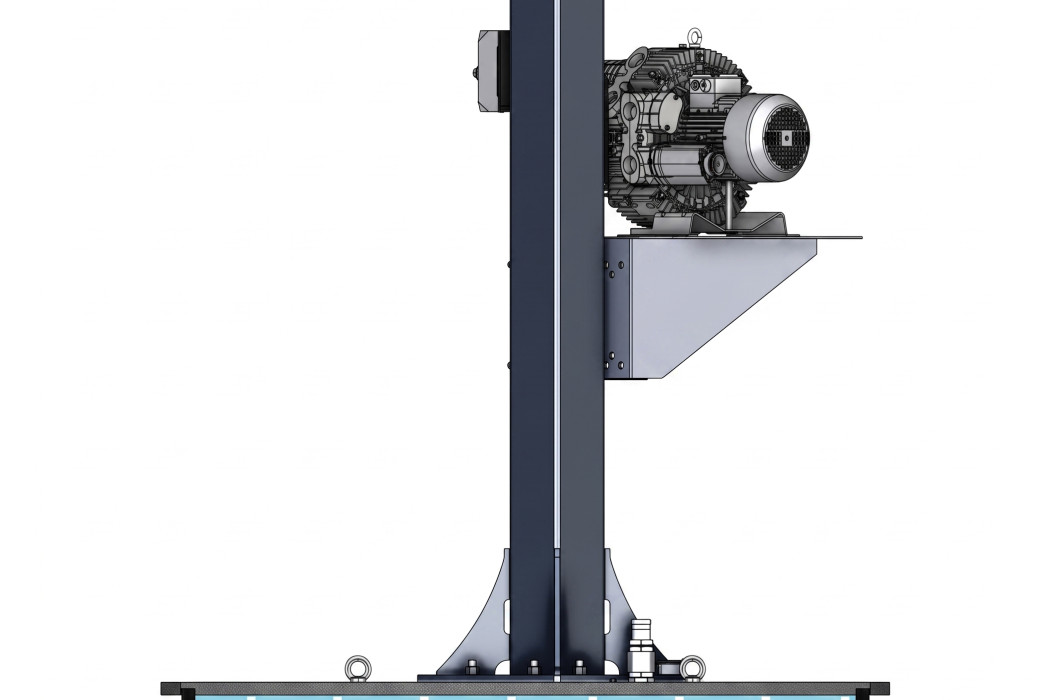

Timmer relies on a different anchoring principle for the "timbaseLIFT." The system combines the "timLIFT" tube lifter with a base plate that is fixed to the hall floor through vacuum. The anchoring uses the vacuum already generated for operating the tube lifter, and according to the manufacturer, no additional vacuum source is required.
This concept allows the manufacturer to dispense with heavy counterweights. While the base plate of conventional mobile cranes weighs about 1.2 tons with concrete bases according to Timmer, the corresponding weight for the "timbaseLIFT" is about 400 kilograms. This corresponds to a reduction of about two-thirds.
Reduced Weight Eases Relocation
The weight reduction is intended to facilitate repositioning within production and logistics halls. For internal transport, the system can be equipped with forklift pockets if necessary, allowing the vacuum lifter to be positioned at different locations.
According to the manufacturer, the reduced weight also simplifies shipping to the customer. At the same time, it expands the range of applications in halls where the static load capacity restricts the installation of heavy crane systems.
The concept is therefore particularly aimed at companies that regularly reconfigure their production or logistics areas and need lifting technology at changing workstations.
Security concept links hub function to ground anchoring
For operational use, Timmer has developed a patented security concept based on three functions. During the lifting process, the active vacuum anchoring ensures the necessary stability. Outside of operation, the base plate assumes this function.
In the event of a sudden power outage, an integrated check valve maintains the vacuum under the base plate. At the same time, the system controls the lowered load safely. According to the manufacturer, the vacuum anchoring remains in place during this process.
An additional security feature arises from the technical coupling between the lifting function and ground anchoring. The tube lifter can only lift loads when the base plate reaches the required vacuum level. If the vacuum is insufficient for safe anchoring, the lift of the load is prevented.
Modular design for different hall heights
The "timbaseLIFT" is modularly constructed and can be adapted to different spatial requirements. The system offers load capacities of up to 85 kilograms and jib lengths of up to four meters.
In addition to the standard version, low-profile variants are available for the aluminum jib. These are intended for locations with limited ceiling height.
Timmer cites typical applications such as handling boxes, canisters, buckets, and sacks. The system is intended to enable ergonomic lifting operations at workplaces where permanently installed crane systems are not feasible due to structural limitations or where frequent relocation is necessary.
Translated automatically from German.
Branchenverzeichnis