Suche
Newsletter abonnieren
News
Branchenverzeichnis


Sonderhefte/Specials

Shuttle-Profis


Fotostrecken

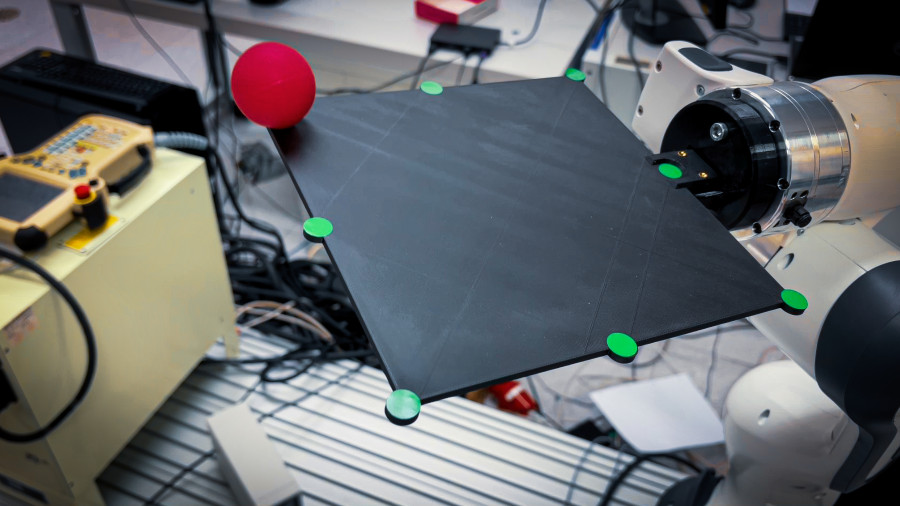
"Karl" moves the ball: Two decommissioned industrial robots demonstrate how machines can learn independently.

University of Paderborn Modernizes Two Systems for Teaching
The University of Paderborn, as part of the project "Articulated Arm Robots in Teaching" (Karl), has modernized two existing industrial robots and put them back into operation for use in university education. Scientific staff and students from the Heinz Nixdorf Institute equipped the robot systems with new sensors and integrated them into simulation and control environments.
The goal was to combine practical applications of robotics with methods of artificial intelligence. According to the university, the systems are particularly intended to support the teaching of machine learning methods.
Kawasaki Robot Receives New Control Interface
The project focused on a six-axis industrial robot from Kawasaki and a seven-axis Franka Emika Panda. Both systems were temporarily unused and were made operational again at the Chair of Control Engineering and Mechatronics. The work included assembly, repair, and commissioning as well as integration into modern software environments.
For the Kawasaki robot, the project team first examined the control in a simulated environment. Subsequently, the participants developed their own interface through which the system could be controlled from external software. Building on this, they were able to plan motion sequences, transfer them to the real robot, and evaluate the executed movements.
The technical revision was carried out with the involvement of scientific staff and student assistants. Three student theses were used to delve deeper into individual aspects of the development. A key project goal was to make existing systems usable for new applications with minimal effort.
Reinforcement Learning for Autonomous Robot Movements
Another focus was on the use of reinforcement learning. In this machine learning method, an algorithm improves its decisions through interaction with an environment. To do this, a learning agent selects certain actions based on available information and then receives feedback on their outcomes. Based on these evaluations, the system gradually adjusts its behavior.
In the "Karl" project, the team examined how such learning methods can be transferred to real industrial robots. The seven-axis Franka Emika Panda served as the test system. One application case dealt with path planning. Here, reinforcement learning was intended to replace the sample-based planning method Rapidly-exploring Random Tree. This method is used to determine possible movement paths in a given space.
In another experiment, the project participants used the Soft-Actor-Critic algorithm to control the robot while balancing a ball. A camera captured the position of the ball on a plate. The learning agent then determined the necessary robot movements to tilt the plate in order to move the ball from the edge towards the center. With these experiments, the participants investigated the practical use of learning-based control methods on real robotic systems.
Pick-and-Place System with Moving Turntables
In addition to the applications of reinforcement learning, a pick-and-place system was developed in another study project. For this purpose, the students combined an existing robot with the sensors already available at the department. The developed application detects objects on a rotating turntable, grabs them, and places them at predetermined positions on a second turntable. Both turntables move during the process.
Thus, the project includes not only simulation-based motion planning but also a practical application for sensor-based object detection and handling. The experimental setup combines the detection of moving objects with the control of an industrial robot and the subsequent positioning of the workpieces.
Simulation Environments for Further Courses
According to the University of Paderborn, the modernized robot systems are ready for use in lectures and practical courses. In addition, demonstration videos were created that convey the basics of articulated arm robotics.
The developed simulation and control environments are intended to be specifically used for practical exercises on reinforcement learning in the future. Students can initially investigate procedures in a virtual environment and then test them on real robot systems.
Another aspect of the project is the reuse of existing technical equipment. Instead of acquiring new robot systems, participants refurbished previously unused equipment and supplemented them with the technology required for the applications. The university thereby connects the practical teaching of robotics and automation technology with a resource utilization-oriented approach.
Translated automatically from German.
Branchenverzeichnis