Suche
Newsletter abonnieren
News
Branchenverzeichnis


Sonderhefte/Specials
Shuttle-Profis


Fotostrecken

ZF reduces manual transport trips through autonomous route trains

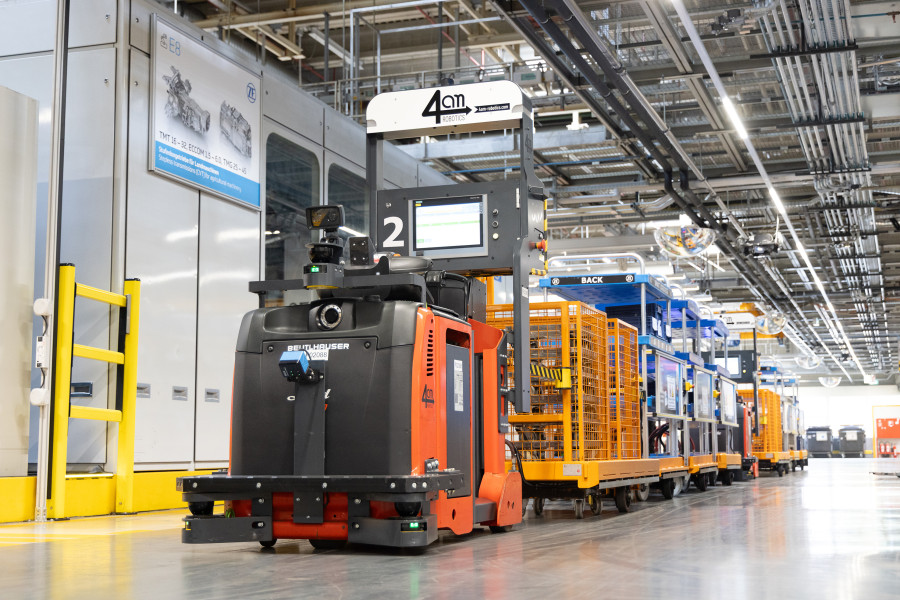
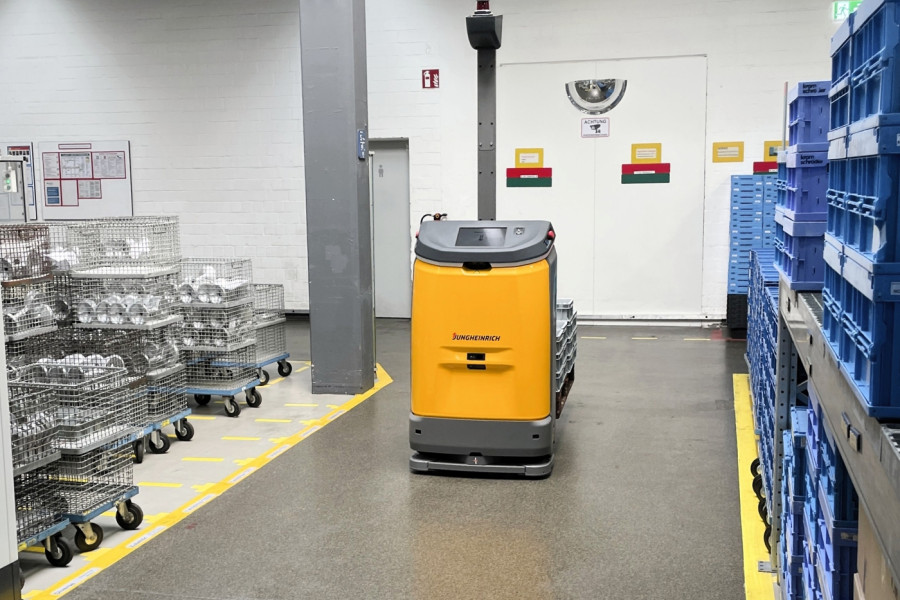
The automotive supplier ZF is using four autonomous tugger trains from 4am Robotics in its Passau-Patriching plant for the material supply of the assembly. According to the automation provider, the driverless vehicles transport approximately 430 shelf trucks and 260 small load carrier towers daily from goods receipt towards assembly. The solution is already in use in regular production operations and is intended to reduce manual transport trips and ensure the supply of the production areas.
Four route trains with four trailers each
Four autonomous route trains of the "ATi-M" series are used, each equipped with four trailers. The vehicles operate between the goods receipt and the assembly performance center. They independently navigate predetermined stops where the necessary materials are handed over.
The picking and provision of the load carriers continue to be carried out by employees in goods receipt. They prepare the shelf carts and small load carrier towers and load the trailers of the route trains. After starting, the vehicles independently determine their driving route. They continuously adjust speed and driving behavior to the respective environment and possible obstacles.
According to 4am Robotics, the solution is designed for demand-driven material supply to the assembly areas. The automated transports aim to relieve employees from manual trips and support the processes between goods receipt and production.
Navigation in Mixed Factory Traffic
A significant challenge in integrating autonomous tugger trains was the traffic conditions within the factory halls. The vehicles move during ongoing production operations on paths that are simultaneously used by pedestrians and manually operated vehicles like forklifts. Additionally, there are sometimes narrow traffic routes.
Therefore, the focus during implementation was on safe navigation, person recognition, and suitable braking and warning systems. Furthermore, the traffic management within the factory was regulated accordingly.
According to ZF, safety in the material flow has improved since the introduction of the autonomous tugger trains. This is due to the elimination of manual transport trips and clearer regulated intersection situations. Employees have also been specifically prepared to handle the driverless vehicles.
Real-Time Monitoring Shows Vehicle Positions
To monitor the transport processes, ZF uses a screen at the home station in the goods receiving area. This shows the current positions of the autonomous tugger trains in real time.
Employees can thus track where the vehicles are and when the next material delivery arrives at the assembly. This monitoring supports coordination between material provisioning, transport, and material reception in production.
During operation, the vehicles continuously transmit status information to the control center. These data also form the basis for communication with employees in the assembly area.
Industry Smartphones Coordinate Material Handover
To coordinate between the autonomous route trains and the employees, ZF has introduced specialized industry smartphones. These devices notify the assembly area employees shortly before a vehicle arrives.
Based on this, they can proceed to the respective stop in time and prepare for the material handover. There, they unload the delivered rack carts, ensure the assembly supply, and prepare empty carts for return transport.
Communication occurs through synchronization between the route trains, the control center, and the mobile devices. The vehicles continuously send status messages, which are used to notify the employees.
If a device fails or is temporarily unreachable, the system, according to the provider, automatically activates an alternative notification chain. This is intended to maintain communication about upcoming material deliveries even in the event of technical disruptions of individual devices.
Material Flow Integrated into Existing Processes
With the route train solution, ZF has partially automated the material transports between goods receipt and assembly. The vehicles take over the internal company trips, while the employees remain responsible for the preparation, loading, and unloading of the load carriers.
The combination of autonomous navigation, central real-time monitoring, and mobile notifications enables a coordinated material supply in ongoing production operation, according to 4am Robotics. However, the company does not provide specific information on investment costs, achieved time and cost savings, or the length of the automated transport routes in its announcement.
Translated automatically from German.
Branchenverzeichnis