TÜV SÜD and Accenture present the "Physical AI Safety Suite" at the NVIDIA GTC Berlin 2026

(ots) At the NVIDIA GTC Berlin 2026, TÜV SÜD and Accenture presented a joint concept for a "Physical AI Safety Suite" designed to help companies deploy physical AI equipment such as Autonomous Mobile Robots (AMR) more quickly and safely alongside human employees. With the help of digital twins, AI agents, and simulations, the "Physical AI Safety Suite" aims to accelerate the automation of factories and warehouses and increase productivity in manufacturing.

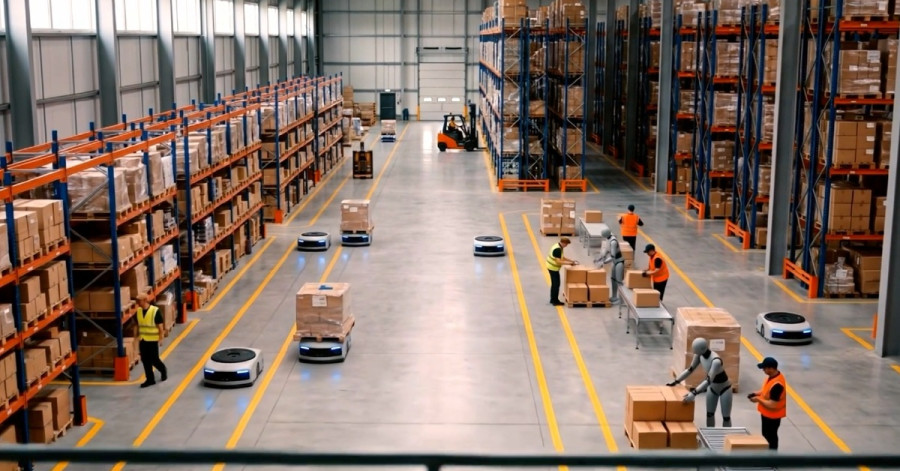
With the help of digital twins, AI agents, and simulations, the "Physical AI Safety Suite" by TÜV SÜD and Accenture aims to accelerate the automation of factories and warehouses. (Image source: Accenture/TÜV SÜD/TÜV SÜD/obs/ots)

The "Physical AI Safety Suite" partially digitizes the manual inspection of equipment and installations, as well as the creation of certification packages, using digital twins and AI-supported simulations. TÜV SÜD estimates that the digital process could speed up commissioning by up to 30 percent. This not only reduces physical dependencies such as installed equipment and on-site inspections; companies can also address safety and certification issues earlier to avoid costly rework during operation.

"Physical AI enables robotic systems to become increasingly adaptable, paving the way for independent, evidence-based digital certification processes," said Patrick Vollmer, CEO and Chairman of the Board of TÜV SÜD AG. "With our 'Physical AI Safety Suite', which is based on simulation-supported evidence, we can support compliance readiness at a much earlier stage of the development cycle, without compromising the accuracy required by our standards. Evaluating automation concepts before the first robot is deployed reduces uncertainties in ongoing operations and helps achieve a higher level of safety, efficiency, and performance in production and logistics." "Companies too often test automation concepts against industry standards only when plants, layouts, and workflows are already determined," said Sarat Maitin, Head of Supply Chain and Engineering at Accenture for Central and Eastern Europe. "The 'Physical AI Safety Suite' shifts these steps to an earlier point when companies can still avoid safety incidents and costly rework. It also enables continuous monitoring of automated facilities. Both support the faster deployment of physical AI-driven automation, which is necessary to boost productivity in manufacturing, particularly in Europe."

Connected Assessments on Three Levels

The concept of the “Physical AI Safety Suite” evaluates automation on three interconnected levels, with TÜV SÜD conducting an independent assessment and assurance, while retaining responsibility for certification:

Level 1: Simulation of Industrial Plant Layouts - Where can companies safely use physical AI?

Using the NVIDIA Omniverse libraries, the open-world model platform “Cosmos,” and the open robotics framework “NVIDIA Isaac Sim,” the “Physical AI Safety Suite" virtually assesses routes, free spaces, mixed-use zones, and cooperation areas before robots are deployed or layouts are reconfigured. It then creates a structured evidence package for TÜV SÜD's review, covering requirements for operating areas, standards for hazard and risk mitigation, norms for robot integration, as well as safety aspects of control systems.

Level 2: Integration of Robot Fleets - How Does Physical AI Work Safely?

With the help of "NVIDIA Omniverse," "Cosmos," and "Isaac Sim," the "Physical AI Safety Suite" simulates robot fleets and their behavior to identify operational constraints and potential hazards before deployment, such as the possibility of employees being trapped by AMRs. During operation, the "NVIDIA Halos" safety platform and the "Edge AI Platform NVIDIA IGX Thor" are used to detect potentially dangerous situations that are outside the field of view of a single robot. AI agents developed based on the "NVIDIA Halos Outside-In Safety Blueprint" extend a robot's perception, enabling it to autonomously draw conclusions and take action using cameras installed in the facility. As a result, fleet management systems can respond earlier to improve safety and operational efficiency.

Level 3: Individual Robots - What Is Physical AI Allowed to Do?

Even devices that comply with all applicable product regulations must be tested under operating conditions intended for the specific location, such as load, speed, floor condition, and lighting. With the help of "NVIDIA Isaac Sim" and "Cosmos," the "Physical AI Safety Suite" creates and tests a variety of scenarios relevant to certification that could practically never be covered in tests under real conditions. This allows engineering teams to determine the best placement for safety sensors, for example, long before a physical prototype exists.

Translated automatically from German.

Printer Friendly, PDF & Email

Branchenverzeichnis

31.08.2026
Datasensing, the business unit for sensors, machine safety, and machine vision of Datalogic, has introduced the safety laser scanner "SLS10". According to the company, the device features a large...
21.08.2026
Neura Robotics takes over the "Active Shuttle" driverless transport system from Bosch Rexroth effective October 1, 2026. This addition complements the portfolio of Neura Mobile Robots GmbH. According...
23.10.2026
The Fraunhofer Institute for Manufacturing Engineering and Automation has, on behalf of Jungheinrich Profishop and the exoskeleton manufacturer Hunic, investigated the ergonomic effects of an...
04.09.2026
From October 14 to 15, Heitec AG intends to present its offerings for retrofit and modernization of existing facilities at Maintenance 2026 in Munich. In addition to the modernization of hardware and...
24.09.2026
Bringing goods directly from receipt to the point of use can avoid additional movements. However, not every material flow is suitable for this process.
21.09.2026
Through a partnership with Plug and Play, the system integrator aims to accelerate the transfer of artificial intelligence into industrial applications and expand its international technology network...