Suche
Newsletter abonnieren
News
Branchenverzeichnis


Sonderhefte/Specials
Shuttle-Profis


Fotostrecken

ABB Robotics expands Fashion Inductor with AI-based "Robot Trainer"

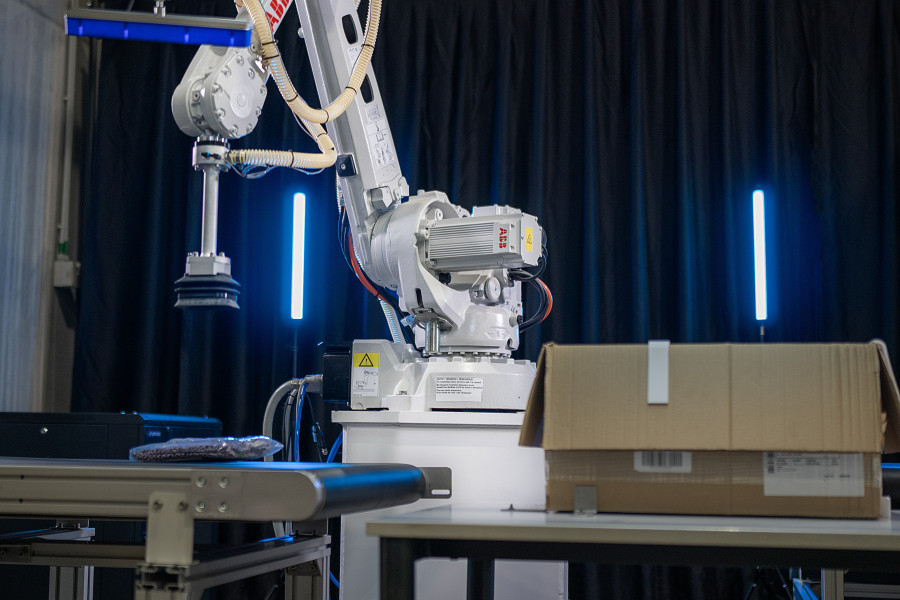
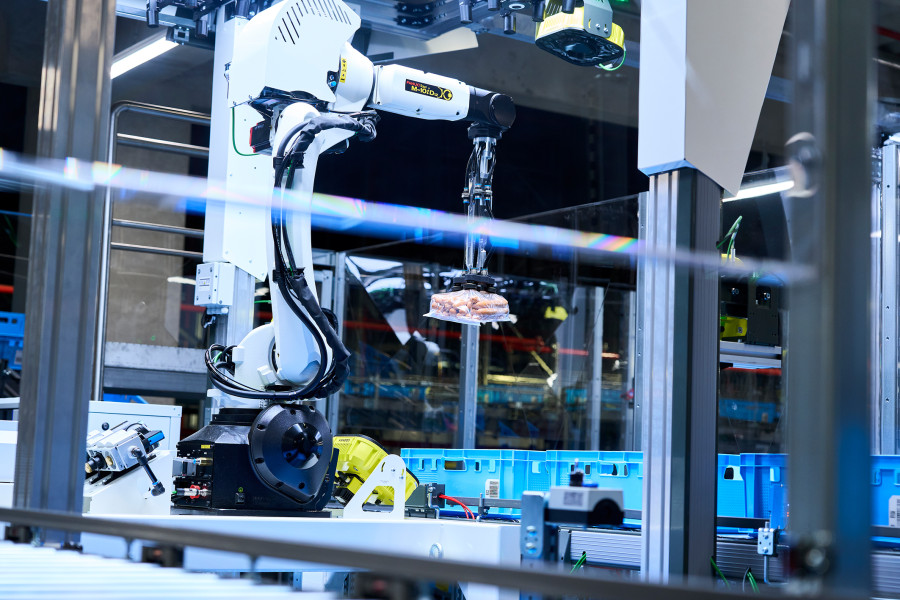
The "Fashion Inductor" is designed for applications where different items, packaging, and changing operating conditions place high demands on automated handling. According to ABB Robotics, the system achieves a throughput of up to 1,300 items per hour and robot cell with a gripping accuracy of more than 99.5 percent. The basis for this is the automatic path planning, the motion precision of the robots used, and an image processing technology specially developed for the application.
Pre-trained AI Models Reduce Integration Effort
With the "AI Robot Trainer," ABB Robotics enhances the existing solution with features of camera-based physical artificial intelligence. This integrates the visual perception of the environment with the control and adjustment of physical robot movements.
The functionality includes pre-trained image processing models tailored to the requirements of fashion and apparel logistics. In addition, there are application-specific tools and functions that allow the models to be retrained when requirements change.
This enables system integrators to implement and adapt robotic applications without needing specialized expertise in developing artificial intelligence. According to ABB Robotics, the combination of pre-trained models and simplified adaptation possibilities reduces the development and commissioning effort by up to 75 percent. The company aims to particularly facilitate the installation and scaling of applications that previously required a high degree of customization due to varying article and packaging characteristics.
Continuous Retraining in the Ongoing Lifecycle of the System
An additional component of the solution is the ability to adjust image processing models throughout the entire lifecycle of a robot application. The "AI Robot Trainer" supports a closed-loop optimization process, which ABB Robotics refers to as a closed-loop workflow. During this process, the performance of the robot cell is monitored and analyzed for deviations. Based on this, the system generates new training data, which can be used to retrain the existing models. The improvements are then transferred back to the robot system.
The retraining is carried out concerning the respective robot cell and its specific operational conditions. In this way, the models are intended to adapt to changed items, packaging, and requirements.
ABB Robotics pursues an approach where the optimization of image processing is not limited to the initial setup of the application but can continue throughout the entire operational period.
"Robotstudio" and "Omnicore" as Technical Foundation
For the virtual planning, simulation, and validation of applications, ABB Robotics uses the "Robotstudio" software. It forms the development environment for the preparation and verification of robot processes.
The "Omnicore" robot control takes over the execution of the applications in production operations. Together with the "Application Controller Platform," automatic path planning, and the "AI Robot Trainer," these components form the technical foundation of the new solution.
The integration of development, control, and training functions is intended to enable the management of robot applications from virtual planning through commissioning to later adjustments within a common system environment.
Expansion to Further Robot Applications Planned
ABB Robotics describes the combination of "Fashion Inductor" and "AI Robot Trainer" as the company's first fully integrated camera-based Physical-AI solution for industrial applications.
The introduction is part of the development of autonomous and versatile robot systems, summarized under the name "Autonomous Versatile Robotics" by ABB Robotics.
By the first quarter of 2027, the company aims to extend the approach based on the "AI Robot Trainer" to additional camera-based robot applications. The functions for adapting and continuously optimizing the models are also to be made available in other industrial application areas.
Translated automatically from German.
Branchenverzeichnis