Suche
Newsletter abonnieren
News
Branchenverzeichnis


Sonderhefte/Specials
Shuttle-Profis


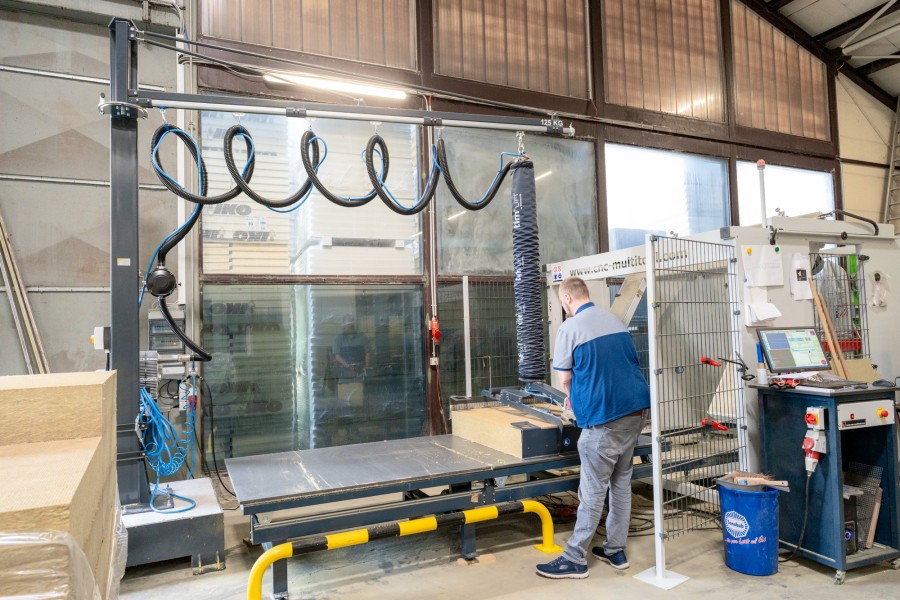
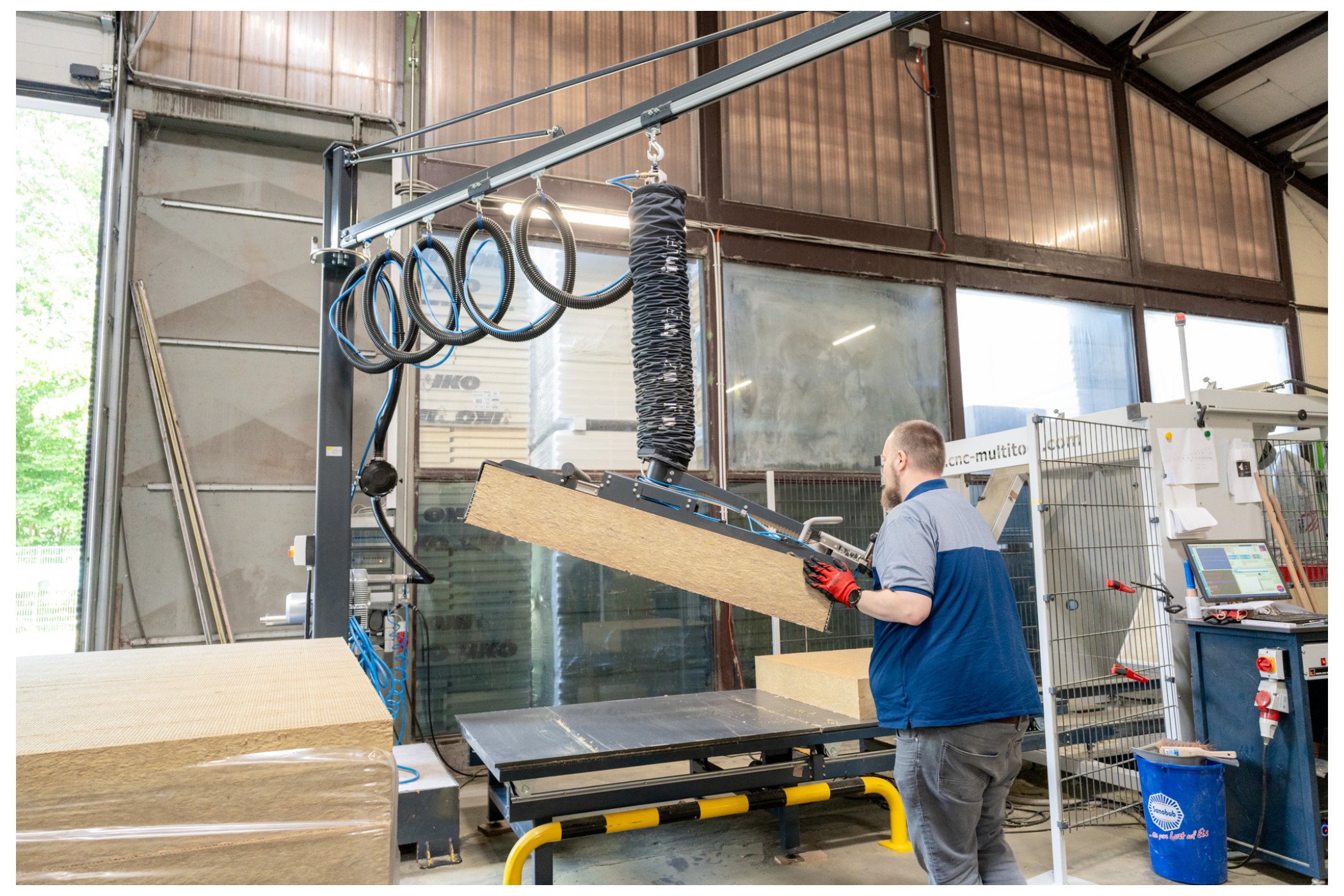
Special solution without long waiting time: Vogelsang relies on a custom-configured hose lifter from Timmer for handling roof insulation boards.
Vogelsang GmbH & Co. KG has been active in the field of roof insulation for 25 years and specializes in the conversion of insulation materials. Various insulation materials are processed, including EPS (Styrofoam), PIR rigid foam, and mineral wool. A focus is on custom slope insulations that are individually planned and tailored for flat roofs. "Every roof is different. That's why we first create the appropriate plans and then tailor the insulation boards according to the order," explains owner Matthias Vogelsang.



Heavy Panels as a Challenge
While other insulation materials are light and therefore easy to handle, the processing of stone wool has introduced new demands on the team since the introduction of a CNC machine in 2025: The most commonly used panels measure 1.20 x 1.00 meters, are 200 millimeters thick, and weigh around 38 kilograms each. In daily operations, approximately 60 to 100 panels are handled. The panels are delivered on pallets, freed from the transport film, and then individually placed onto a CNC cutting machine. There, they are cut into tapered insulation according to the order.
At the start of the new manufacturing process, the material was still inserted very laboriously by hand. However, it was already clear that the process needed to be simplified.
Individual Solution for a New Process
At the Logimat in Stuttgart, Matthias Vogelsang was specifically looking for a suitable solution. Several providers were considered. It turned out that direct suction was not an option due to the porous nature of the material. Building on the conversation with Timmer at the booth, the Neuenkirchen company developed a special solution with a custom-made gripper: the material is not suctioned, but clamped. For optimal construction, Vogelsang provided a sample of the material to Timmer after the trade fair, so the gripper could be designed and tested directly with the original material.
Dirk Lütke-Bohmert, Sales Engineer at Timmer, reports: "In such applications, it is crucial to understand the customer's process precisely and develop an optimal solution from it." In the case of Vogelsang, the particular challenge was to securely grip the heavy yet delicate material without unnecessarily complicating the workflow.
Quickly installed, quickly in use
From the first contact at the trade fair to productive use, less than half a year passed. "For a custom solution including a new design of the gripper – absolutely great," Vogelsang is pleased to say. The familiarization process was also straightforward. "The operation is learned in just a few minutes," reports Vogelsang. Nowadays, alternating employees use the hose lifter to position the stone wool panels onto the CNC cutting machine and cut them according to orders.
With classic slope roof panels, the hose lifter can subsequently pick up the cut panel as a whole and place it on a new pallet. For many small cuts, this step is still done manually. In everyday work, the hose lifter mainly relieves the strain on employees' backs and ensures the process remains practical even with higher order volumes. "Handling the stone wool panels has become much more straightforward and faster with the hose lifter," says Vogelsang.
Flexible lifting technology for dynamic processes
Another advantage is flexibility. The "mobile" crane unit can be repositioned using a forklift or pallet jack. This was particularly important for Vogelsang because the final workflows were not fully defined at the project's start. "When starting with a new product, you first have to familiarize yourself with the workflows. It can happen that you need to reposition a machine," he explains.
For Vogelsang, the project is not yet complete. If the company expands its stone wool processing, another lifting solution might come into play. One possibility could be a ceiling system with a larger work area. What is already clear for him: "The hose lifter enables material-friendly and economical handling of the materials while also significantly preserving the employees' health."
Translated automatically from German.
Branchenverzeichnis