Suche
Newsletter abonnieren
News
Branchenverzeichnis


Sonderhefte/Specials
Shuttle-Profis


Port of Tilbury tests fuel cell reach stacker in operation
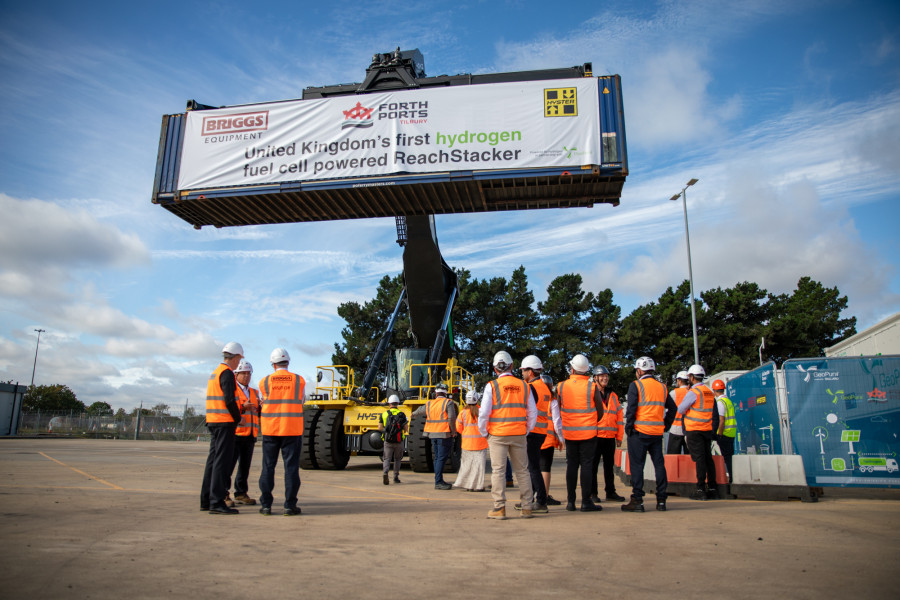
Hyster and Briggs Equipment have delivered a reach stacker powered by a hydrogen fuel cell to the Port of Tilbury in Essex, United Kingdom. According to the companies, it is the first container stacker of this type of drive to be used in a real port application in the United Kingdom and is fully operational there. The test run before series production is intended to provide insights into the use of the technology in heavy-duty operations.
Fuel Cell Powers Lithium-Ion Battery
The reach stacker is equipped with a fuel cell engine from Nuvera with a power output of 60 kilowatts. This converts hydrogen into electrical energy and supplies a lithium-ion battery with a capacity of 130 kilowatt-hours.
According to Hyster, the system is based on insights from previous pilot programs. This includes a pilot project completed last year with a fuel cell reach stacker in Valencia. Hyster and Nuvera have further developed and scaled the fuel cell system based on these experiences. For vehicle control, the reach stacker uses the standardized software architecture from Hyster, which is also used in other electrically powered vehicles from the manufacturer.
32 kilograms of hydrogen on board
High-pressure tanks store 32 kilograms of hydrogen on the vehicle. According to the manufacturer, this capacity is intended to allow operation over a complete twelve-hour shift. Hyster states that refueling takes less than 30 minutes.
According to the project partners, the reach stacker is fully powered by green hydrogen. GeoPura provides the infrastructure for generation, supply, and refueling on site. The hydrogen is produced using an electrolyzer.
Test under real port conditions
The project is intended to test fuel cell technology under the demands of container handling. Hyster specifically cites intensive work cycles as a scenario for deployment.
Service and maintenance of the reach stacker will be handled by Briggs Equipment on-site. Additionally, Hyster supports the project with expertise in hydrogen fuel cells and high-voltage systems. This should enable the port to evaluate the technology under real operating conditions.
More than 107 tonnes of carbon dioxide per year
According to Hyster's calculations, the hydrogen-powered reach stacker should reduce carbon dioxide emissions by more than 107,000 kilograms per year. The manufacturer bases this figure on a diesel consumption of 40,000 liters per year at an average of 2,500 operating hours and a tank-to-wheel emissions factor of 2.68 kilograms of carbon dioxide per liter of diesel.
The calculation thus considers the direct emissions in vehicle operation. The Port of Tilbury belongs to the Forth Ports Group, which, according to the source text, aims to achieve net zero emissions for greenhouse gases by 2042.
Translated automatically from German.
Branchenverzeichnis