Suche
Newsletter abonnieren
News
Branchenverzeichnis


Sonderhefte/Specials
Shuttle-Profis


Fotostrecken
Ergonomics in intralogistics: Movement sequences determine the selection of handling technology


How often and for how long do professionals lift workpieces? Do they reach above shoulder height, or do they work with a twisted upper body? Do they repeatedly hold, push, or pull goods? These questions are essential when companies evaluate workplaces. A cycle plan shows how fast a process should run. It does not show how people actually grasp, lift, turn, and set down workpieces.
Therefore, those responsible should observe the process directly at the workplace, because a process may appear smooth on paper. In everyday life, however, employees grasp differently, maneuver, or twist in tight spaces. Interruptions and differences between the planned and actual process also provide insights.


From Observation to Suitable Solution
Employees are familiar with deviations from the standard procedure, tight spaces, and actions that are not documented in any work instructions. Their knowledge makes the analysis practical and helps to develop a solution for the specific task. A test at the workplace shows whether they can accept and safely use the support in their daily routines. And it reveals whether the system actually facilitates the task.
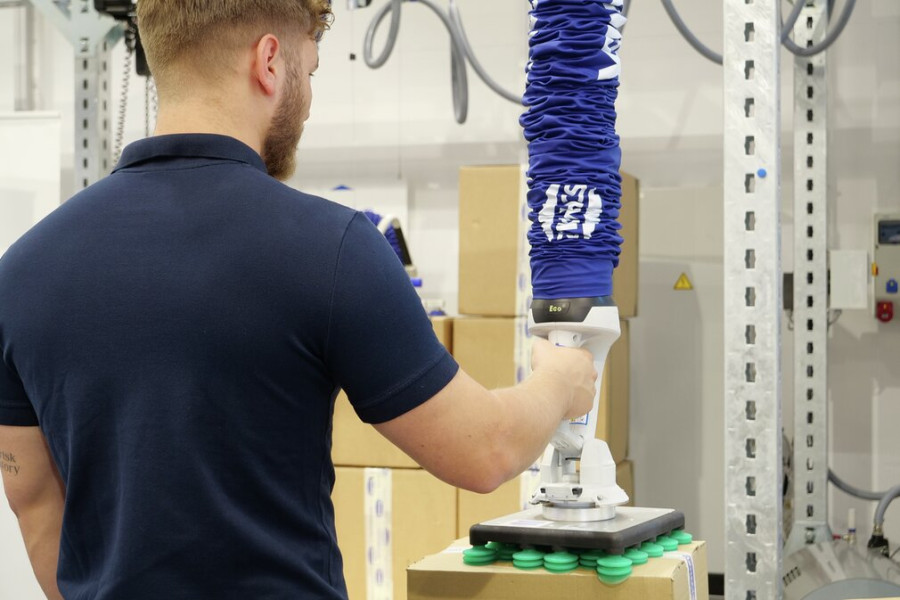
What support is suitable depends on the workpiece and the process. Sometimes it suffices to provide material differently or to change the working height. For rapid movements with workpieces up to 50 kilograms, a vacuum tube lifter like the "Jumboflex" from Schmalz GmbH can relieve employees. For heavy or large-scale goods, vacuum lifting devices like the "Vacumaster" are considered. The quantity, variants, and space conditions also determine which solution is suitable. "Technology is not an end in itself. The system must facilitate the specific task, be easy to operate safely, and fit the material flow," says Eric Wilhelm, Head of the Handling Business Unit and member of the executive board at Schmalz.
Practical Example from Parcel Logistics
At DPD Netherlands, the Destuff-it mobile conveyor system and the "Jumboflex" vacuum tube lifters reduce manual lifting efforts by 80 percent. At the same time, employees unload trailers an average of 15 minutes faster.
For work preparation, therefore, it's not just the intended cycle that counts. Those responsible also check what movements the process requires from the employees. By doing so, they incorporate ergonomics into the workflow from the beginning, instead of adding it later.
Translated automatically from German.
Branchenverzeichnis