Suche
Newsletter abonnieren
News
Branchenverzeichnis


Sonderhefte/Specials

Shuttle-Profis


Fotostrecken
Datalogic: New software recognizes packages even with unreadable barcodes

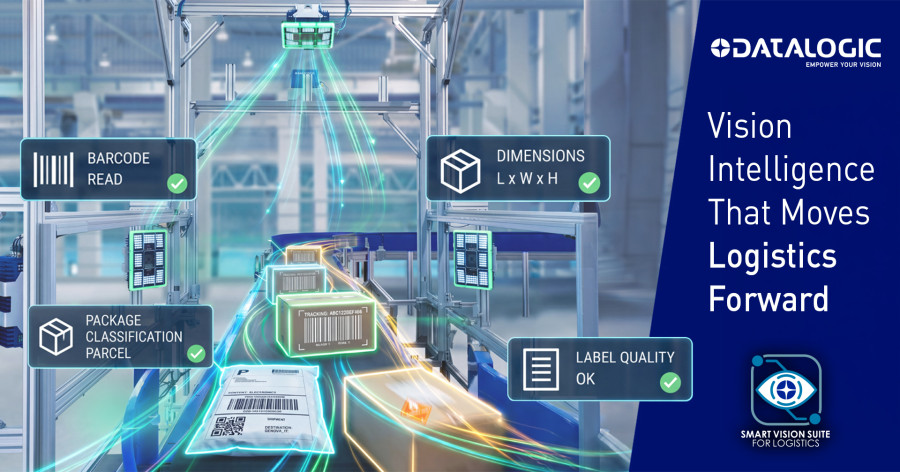
Datalogic introduced the software platform "Smart Vision Suite for Logistics" last week. The modular solution complements automatic barcode capture in logistics facilities with functions for image analysis and text recognition. According to the manufacturer, this allows additional information about shipments to be utilized for automated processes. At market launch, four software modules are available to handle different tasks in shipment identification, package inspection, and the processing of visual information.
The "Smart Vision Suite" is integrated into Datalogic's reading tunnel architecture and builds on the monitoring software "Web Sentinel." While this centrally consolidates operational data, the new platform enhances existing functions with the evaluation of image information. In addition to barcodes, printed texts, handling symbols, packaging features, and visible damages can be captured and analyzed.
Four Modules for Different Applications
The software encompasses four modular applications at market launch. The "Label Blurring" module detects personal information on shipping labels and automatically conceals this data. This allows names and addresses to be obscured before the storage or transmission of image data. This function is intended to help companies comply with the requirements of the General Data Protection Regulation.With "Pattern Recognition," visual markings on shipments that are not captured via barcode can be identified. These include hazardous material markings, weight information, and special handling instructions. The automatic recognition of such features aims to identify shipments with special requirements and prevent sorting errors.
The "Item Inspection" module analyzes characteristics of packages such as material, shape, and visible damage. This allows logistical facilities to distinguish non-standard shipments based on their external features. According to Datalogic, customer-specific images can be used for training in image recognition. This allows the application to be adapted to different operational requirements.One potential application area mentioned by the manufacturer is baggage handling at airports. There, image analysis can distinguish between hard-shell suitcases and soft luggage, thus supporting their forwarding.
Text Recognition for Unreadable Barcodes
The fourth application, “No-Read Recovery,” is designed for situations where barcodes are damaged or unreadable due to reflections. In such cases, the software analyzes the text printed on the shipping label to recover the information needed for shipment tracking.
According to Datalogic, this is successful for up to 80 percent of the affected packages. The function is intended to prevent shipments from being diverted from the automated material flow and manually processed due to missing barcode data. The application particularly aims to reduce exceptions in automatic identification.
Retrofitting of Existing Systems Possible
The "Smart Vision Suite" can be used in both new and existing Datalogic systems. The manufacturer offers the software as a retrofit solution and fully integrated into the image-based barcode reader "Datalogic Matrix 930 Premium".
The unified software architecture supports different hardware configurations. Based on "Web Sentinel", operators can activate additional image processing functions through a flexible licensing model. According to the manufacturer, activation is also possible remotely. This allows existing systems to be gradually expanded with additional applications.
Use in Various Logistics Fields
Datalogic lists, among others, courier, express, and parcel services, distribution centers, airport logistics, as well as companies from retail, fashion logistics, and e-commerce as target groups. External logistics service providers are also among the intended users. With the modular platform, the manufacturer aims to complement the predominantly barcode-focused automatic data capture with additional image information. Further applications are planned for upcoming software versions.
Translated automatically from German.
Branchenverzeichnis