Suche
Newsletter abonnieren
News
Branchenverzeichnis


Sonderhefte/Specials
Shuttle-Profis


Fotostrecken
AI robots learn in the factory: FMC³ Robotics tests a new approach

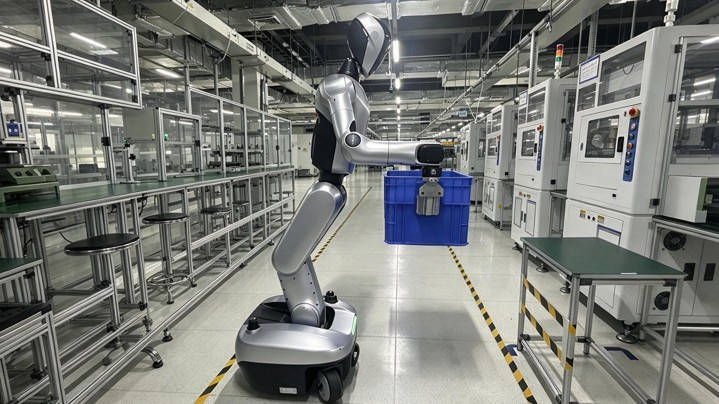
FMC³ Robotics is working on two industrial feasibility studies for the use of robots with artificial intelligence. According to a company announcement, the projects deal with mobile material handling in the production of consumer electronics and the handling of electrode sheets in battery cell production. The focus is on how robots can develop task-specific skills based on real production data and adapt them to changing requirements.
The company, founded in Bavaria with branches in Ingolstadt and Shanghai, relies on Embodied AI (artificial intelligence). An agent platform for industrial robots combines data collection, simulation, training, validation, and deployment of systems into a closed data loop. Feedback from ongoing operations is to be incorporated into the further development of robot capabilities.
Mobile Manipulator for Container Transport
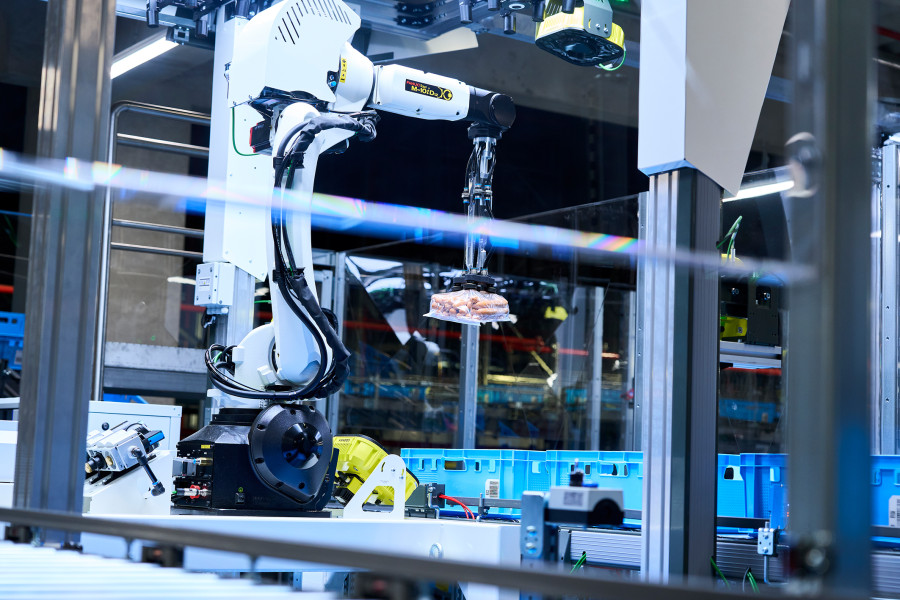
In a plant for the production of consumer electronics, the provider is testing a wheel-based robot for mobile material handling. Under controlled test conditions, the system is supposed to execute a coherent sequence of tasks. These include picking up a container, transporting it to the production area, positioning it next to a facility, and depositing the container at a defined handover point of the production line.
A technical challenge lies in handling different container sizes and operating at various workstations. Neither the traffic routes nor the production facilities were specifically redesigned for the robot. Therefore, the mobile manipulator is expected to meet different production requirements without the need for extensive modifications to the existing production lines.
Robots for Battery Cell Production
Another feasibility study focuses on the processing of electrode sheets in battery cell production. Until now, an employee takes on the task of picking up electrode sheets from a side table, placing them on a corresponding storage tray, and then returning the device to its starting position. In the future, a robot will take over the gripping, transport, storage, and positioning operations. Integration into existing equipment and tools requires precise control of the gripping and storage positions as well as adherence to the specified process sequence.
With both projects, FMC³ Robotics aims to investigate how well robots can adapt to different materials, workplaces, and deviations in the production process. In addition to carrying out individual work steps, the interaction of AI models, robot platforms, and production processes will be evaluated. The company cites metrics such as cycle times, positioning deviations, and continuous operating time.
Data Collection During Ongoing Production
For training the robotic systems, FMC³ Robotics relies on the collection of task-specific data directly in the production environment. Employees can continue with their regular activities without needing to replicate workflows specifically for robot training.
The system captures visual and depth information from the employees' perspective, as well as body and hand movements and the sequence of work steps. Tactile information is added as needed. In addition to the actual activities, the training data should also reflect any deviations and corrections made. This approach aims to enable the consideration not only of individual motion sequences but also their integration into existing production processes during robot training.
Four Components for Robot Training
The technical basis of the data cycle is the "Doceo Data System." It comprises four components that handle various tasks from data collection to the integration of developed capabilities into robotic systems. For collecting multimodal data, "Doceo RealCap" combines intelligent camera headsets, external cameras, and gloves with tactile sensors if needed. The component "Doceo Hub" synchronizes different data streams, merges information from multiple perspectives, and supports the recording, playback, annotation, and management of the data.
"Doceo Cloud" utilizes technologies from Vector Informatik and is designed for operation on a planned standardized data infrastructure. The component supports data acquisition, automatic labeling and preparation of data, as well as training, simulation, and conducting tests. Through "Doceo Driver," the developed capabilities can be linked with various robot platforms and control systems. The consistent traceability of the data basis, as well as the training and validation conditions, is intended to help industrial customers assess the suitability of the robot capabilities for further applications.
Joint Venture for Industrial Data Infrastructure
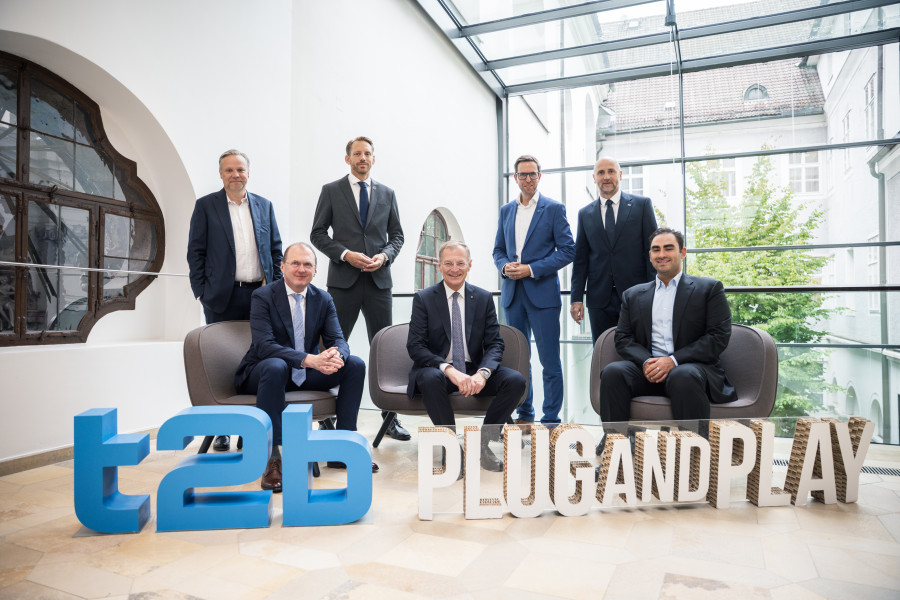
To expand the data cycle to different factories and applications, Vector Informatik, PEM Motion, and FMC³ Robotics are planning to establish a joint venture in Germany. This venture is intended to create a standardized data infrastructure for industrial Embodied AI.
FMC³ Robotics will contribute its agent platform and technologies for task-specific data collection. PEM Motion will provide expertise in production planning and industrialization. Vector Informatik is expected to supply standardized data and communication protocols, expertise in data management and compliance with data-related regulations, as well as intelligent data loggers with support for decentralized artificial intelligence. Data management is to be conducted via the "Vector SDX Cloud." Depending on customer requirements, the planned architecture envisages the use of cloud services located in Germany, such as the "Stackit Cloud" or the "Deutsche Telekom Cloud."
Reusable Capabilities for Further Robotic Applications
In the long term, FMC³ Robotics aims to build a platform for self-learning robotic systems. These systems are intended to identify potential for improvement based on the outcomes of completed tasks, determine the need for additional training data, and reintegrate further developed capabilities back into the production environment for validation.
With an increasing number of reusable robotic capabilities, the company reports that the introduction times for new tasks and deployment environments could be shortened. This is particularly intended to support adaptation to small batch sizes, high variant diversity, and frequent product changes. According to FMC³ Robotics, the two industrial projects are still in the feasibility study phase. Further tests are to show the extent to which the developed capabilities can be transferred to other production environments.
Translated automatically from German.
Branchenverzeichnis